
Hot Products
What is a Savonnerie carpet and how is it made?
Views : 2797
Update time : 2008-08-06 12:41:00
The Savonnerie got its start when Henri IV (King of France from 1589 to 1610) became alarmed by how rapidly the national treasury was being depleted by the importation of Oriental rugs and luxury textiles from the east to satisfy the growing appetite for these goods among his nobles who were keen to emulate the extravagant furnishings of the royal palaces. Henri decided to stop the drain of French silver by setting up the manufacture of Oriental Carpets within France and by reviving the manufacture of the French indigenous luxury products the making of which had declined during the civil strife caused by the Wars of Religion.
Henri IV asked Pierre DuPont, who had traveled in the Levant, to start the manufacture of carpets and provided him with workshop space within the Louvre palace itself.
In 1627 Louis XIII (King of France from 1610 to 1643) granted DuPont and his former apprentice Simon Lourdet an eighteen year monopoly for making carpets. DuPont and Lourdet eventually quarreled and Lourdet set up a separate carpet workshop in a disused soap factory (French savon) and the rugs made there became known as Savonnerie rugs.
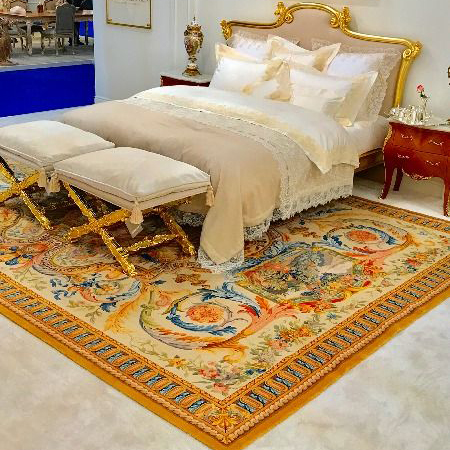
These early Savonnerie carpets were made of wool and are made in the Ghiordes knot (also known as the Turkish knot). In the beginning they made copies of Persian rugs, but eventually a distinctive French style emerged featuring dense flowers and leafy vines inspired by patterns found in the friezes of classical Roman buildings as well as pictorial or armorial framed medallions all enclosed within multiple borders. The background colors were deep blue, black and deep brown. The medallions and borders could have cream backgrounds.
Henri IV asked Pierre DuPont, who had traveled in the Levant, to start the manufacture of carpets and provided him with workshop space within the Louvre palace itself.
In 1627 Louis XIII (King of France from 1610 to 1643) granted DuPont and his former apprentice Simon Lourdet an eighteen year monopoly for making carpets. DuPont and Lourdet eventually quarreled and Lourdet set up a separate carpet workshop in a disused soap factory (French savon) and the rugs made there became known as Savonnerie rugs.
These early Savonnerie carpets were made of wool and are made in the Ghiordes knot (also known as the Turkish knot). In the beginning they made copies of Persian rugs, but eventually a distinctive French style emerged featuring dense flowers and leafy vines inspired by patterns found in the friezes of classical Roman buildings as well as pictorial or armorial framed medallions all enclosed within multiple borders. The background colors were deep blue, black and deep brown. The medallions and borders could have cream backgrounds.
Related News
Read More >>
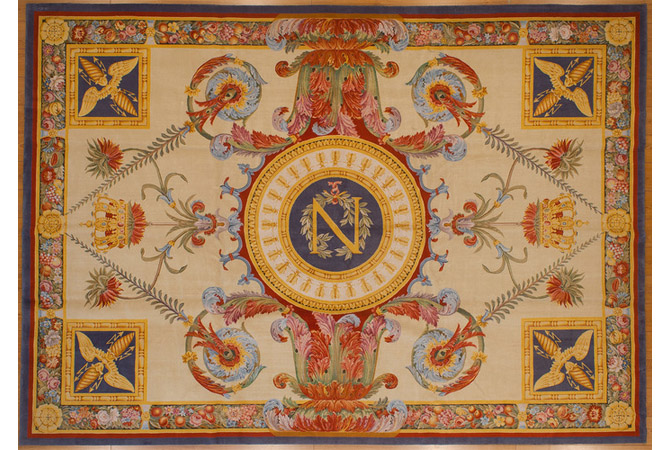 What is savonnerie rug meaning?
Sep .11.2023
A Savonnerie carpet, also known as a Savonnerie rug, refers to a type of luxurious, handwoven carpet or rug that originated in France in the 17th century. The term "Savonnerie" is derived from the French word for soap, "savon," because the original worksh
 Are handmade carpet worth it?
Sep .05.2023
Handmade carpets can be worth it for several reasons, and their value often depends on your preferences, budget, and the specific qualities you are looking for in a carpet. Here are some factors to consider when deciding if a handmade carpet is worth it:
 Celebrate The Chinese New Year
Jan .16.2023
The Chinese New Year holiday is coming. Chengdi Carpet will have a holiday from January 21st to January 27th.
 What are the benefits of handmade silk rugs?
Apr .18.2022
Handmade silk carpet is expensive to be called "soft gold", but why is still loved by more and more people, today we will tell what benefits handmade silk carpet has:


